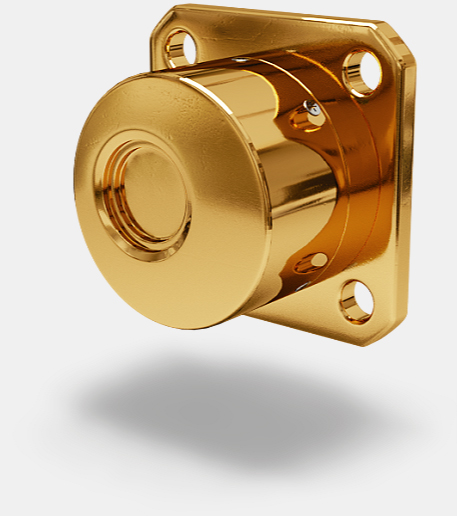

Building on the success of the Mark 20, we have continued to improve the design with the Mark 26. The most noticeable difference is the way the MK26 is mounted. The MK26 is equipped with a solid copper mounting flange. This new flange simplifies mounting and provides excellent thermal conductivity. All TQCMs are designed to utilize a heatsink or mounting flange that will remain near ambient temperature. A cable connector has been added to the rear for convenience. An in-situ peltier and temperature sensor provide controllable heating and cooling capabilities to bring the temperature of the crystals to a temperature at which a gas of interest will condense on the crystal so that it can be measured.
The MK26 can be purchased with custom crystal frequencies to enhance mass measurements or sensitivity measurements down to the mono-molecular level.
The MK26 features a Peltier (thermoelectrically-controlled) heat exchanger which is used to raise or lower the temperature of the crystals. This feature is useful for outgassing tests at low temperatures without supplying any refrigerant. Also, by actively cooling the heat sink, the lowest temperature attainable by the crystal is further reduced. The differential temperature that was available at ambient temperatures is reduced by the Joule heating effect, which cancels out the cooling capacity.
The MK26 has four design configurations:
When used in a vacuum chamber, the MK26 TQCM is used with a QCM Research Model 2000 Control/Data Acquisition Unit. The M2000 is able to handle up to twelve MK26 TQCMs at one time, and communicates with a host computer over an industry standard RS 232 serial link.
When used in flight, the MK26 TQCM is controlled with a QCM Research Model 3000 Flight Controller. The M3000 is modular in design and can control two QCMs per module, with up four modules per M3000 providing eight QCM channels.